
Western Red Cedar siding remains a leading choice for architects who want natural warmth on modern building facades. Vertical grain boards show tight, straight growth rings that create clean lines across contemporary exterior walls. Beyond appearance, you gain measurable advantages in stability, finish performance, and long-term weathering behavior.
Grain orientation starts at the sawmill, where sawyers cut each log to produce flat grain or vertical grain boards. The cut determines how much each board shrinks, swells, cups, and holds paint or stain over time. Here, you will learn why architects specify vertical grain cedar and how to choose the right profile.
Why Do Architects Specify Vertical Grain Western Red Cedar Siding?
Architects specify vertical grain Western Red Cedar siding because it shrinks and swells less than flat grain boards. Reduced movement lowers stress on paints and stains, so finishes last longer between maintenance cycles. The straight, linear grain pattern also complements the clean geometry of modern residential and commercial designs.
How Vertical Grain Western Red Cedar Differs From Flat Grain
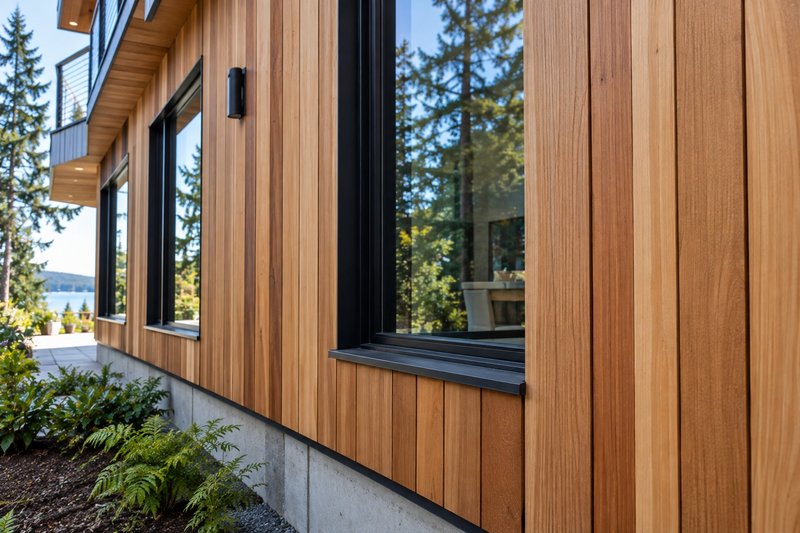
Vertical grain boards come from logs sawn so the growth rings run nearly perpendicular to the board face. Flat grain boards, in contrast, show growth rings that run roughly parallel to the face and form cathedral patterns. Most standard lumber grades contain a high share of flat grain because the cut uses logs more efficiently.
Wood moves more in its tangential direction than in its radial direction as moisture levels change. As a result, vertical grain boards hold their shape with less cupping, twisting, and surface checking. According to Shakertown, flat grain material can move up to 50 percent more than vertical grain material.
Western Red Cedar adds a further advantage, since its low density limits shrinkage compared with heavier softwoods. Cedar also carries narrow bands of dense latewood, which gives finishes a more uniform surface to grip.
Clear Vertical Grain grades combine the stable cut with a nearly knot-free surface. For that reason, many architects reserve Clear Vertical Grain siding for prominent facades and entry elevations. Knotty grades, meanwhile, give you a more rustic texture at a lower cost for secondary elevations.
Performance Benefits Architects Look for in Exterior Siding
Architects weigh appearance, durability, and maintenance demands when they select cladding for a building envelope. Vertical grain Western Red Cedar siding addresses each of those priorities through its structure and natural chemistry. Here are the key performance benefits that support its use on modern residential and commercial projects.
- Dimensional stability: Reduced shrinking and swelling helps boards stay flat and keeps joints tight through seasonal changes.
- Longer finish life: Less wood movement places less stress on paint films and solid-color stains.
- Fewer surface cracks: Vertical grain boards resist the surface checking that lets moisture enter flat grain boards.
- Clean linear appearance: Straight grain lines complement the crisp geometry common in contemporary architecture.
According to Abodo, flat grain timbers show more surface cracking over time, while vertical grain boards hold coatings longer. Consequently, you spend less time on refinishing and surface preparation across the life of the facade.
Cedar still needs periodic care, and our guide on whether cedar needs sealing explains your finishing options. However, the reduced movement of vertical grain boards stretches the interval between those maintenance tasks.
Specifying Western Red Cedar Siding Profiles and Finishes
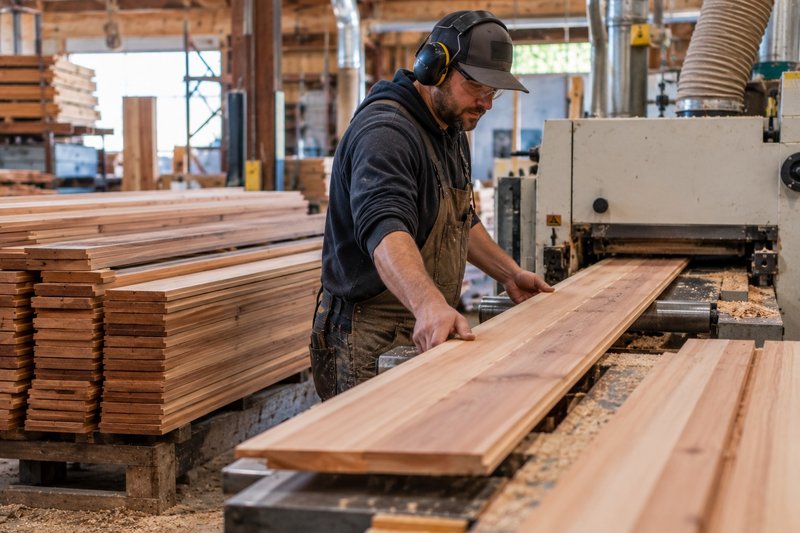
Profile selection shapes how Western Red Cedar siding reads on a facade and how it sheds water. Bevel siding installs horizontally on exteriors, while tongue and groove and shiplap work inside or outside. Shiplap also offers a lap and gap look that creates crisp shadow lines on contemporary homes.
Our siding and ceiling team can help you compare profiles, edge details, and grades for your elevations. Additionally, you should pair smooth vertical grain faces with film-forming finishes and rough faces with penetrating stains.
Some projects call for lower upkeep than natural wood provides, especially on tall or hard-to-reach walls. In those cases, Trespa Pura cladding delivers wood grain decors with super low maintenance and no staining ever required. Occasional washing keeps Trespa Pura looking fresh, and NewTechWood cladding offers another durable, low-maintenance composite option.
Thermally modified siding such as Sicaro and Thermo Ayous from Maximo gives you another stable wood alternative. Heat treatment reduces how much the wood absorbs moisture, which limits swelling and shrinking on exterior walls. For a deeper comparison, read our analysis of composite siding versus natural wood weathering over time.
Plan Your Next Cedar Siding Project With Our Team
Vertical grain Western Red Cedar siding gives you stability, finish longevity, and the clean lines modern designs require. Profile and finish choices then determine how the facade performs through years of sun and rain. When upkeep is a priority, Trespa Pura, NewTechWood, and thermally modified siding broaden your cladding options.
Our specialists help architects, builders, and homeowners match siding grades and profiles to each elevation and budget. Share your drawings or finish schedule, and we will recommend materials that fit your design intent. Reach out to our siding specialists today to discuss grades, pricing, and availability for your next facade.