
Thermally modified lumber has entered a new phase as builders combine heat treatment with fire retardant chemistry for safer homes. Homeowners in wildfire-prone regions now want cladding, decking, and structural wood that resists ignition without losing its natural warmth. Fire retardant thermally modified lumber meets both goals with proven testing, code compliance, and long service life.
The demand comes from real losses on the ground across the country each year. According to the International Code Council, more than 4,500 structures were destroyed by wildfire in 2024, including over 2,400 homes. As a result, builders are rethinking material choices for exterior walls, soffits, decks, and framing exposed to embers.
What Is Fire Retardant Thermally Modified Lumber?
Fire retardant thermally modified lumber is wood heated in low-oxygen chambers, then pressure-infused with a fire retardant chemistry. The heat step improves dimensional stability and rot resistance, while the treatment slows flame spread and cuts smoke development. Together, the two processes create a wood product engineered for demanding exterior and interior fire-rated applications.
How Thermally Modified Lumber and Fire Retardants Work Together
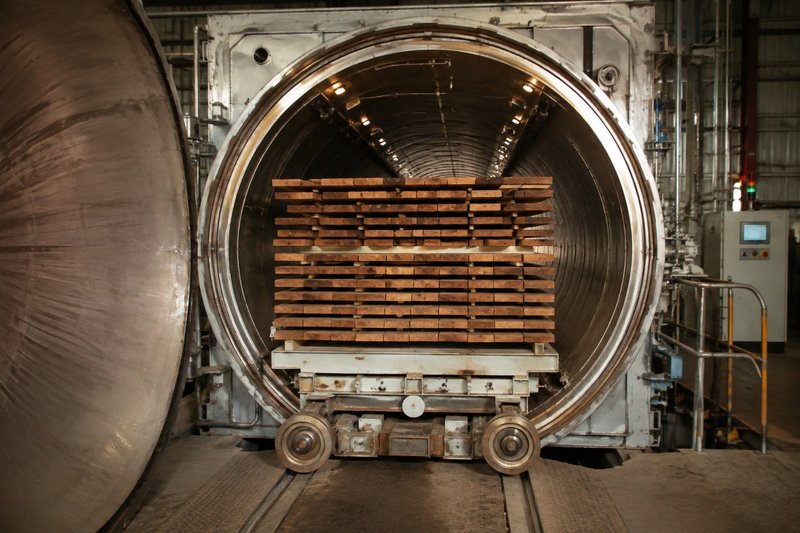
Thermal modification heats wood to roughly 180 to 215 degrees Celsius inside sealed kilns with very little oxygen. As a result, sugars and moisture inside the cell walls break down, which reduces future swelling, shrinkage, and food sources for decay fungi. The wood emerges darker, lighter in weight, and far more stable across humid and dry seasons.
Fire retardant treatment then adds a separate layer of protection through vacuum pressure impregnation. Then the treated boards move to curing ovens, where water-soluble chemistry converts into a bonded resin locked deep in the cell structure. According to Thermory's fire retardant program, the process delivers durable exterior protection on thermally modified ash, pine, and spruce.
The combined result is thermally modified lumber that resists warping while meeting strict flame spread limits. Meanwhile, moisture, sun, and freeze cycles no longer pull the treatment out of the wood. You get long-term performance in the exact zones where builders once avoided real wood entirely.
Fire Performance Ratings for Thermally Modified Lumber
Building officials want documented evidence, not marketing language, before approving any exterior wood on a fire-rated wall. However, thermally modified lumber with fire treatment is tested against the same industry benchmarks used for other code-approved materials. You can request test reports before you specify or install a single board on a project.
The two most common tests are ASTM E84 for surface burning and the extended ASTM E2768 30-minute burn test. Fire Retardant Treated Wood (FRTW) must show a flame spread index of 25 or less, plus no significant progressive combustion during the extended test period. According to Woodworking Network, low oxygen content during heat treatment already prevents burning at the temperatures used inside the kiln.
Testing categories to request from your supplier include:
- ASTM E84 flame spread and smoke development index
- ASTM E2768 30-minute extended burn test for Class A rating
- ASTM D5664 for strength effects after fire retardant treatment
- Wildland Urban Interface (WUI) compliance for exterior use
- ICC-ES evaluation reports tied to current building codes
Additionally, ask for third-party listings from UL or ICC-ES that match the assembly you are building. Documentation protects your permit, your insurance conversation, and your client relationship if an inspector questions the material later.
Where Thermally Modified Lumber Fits in Modern Homebuilding
Fire retardant thermally modified lumber shows up in the parts of a home that get the most weather and the most ember exposure. Siding, soffits, fascia, decks, pergolas, and exposed ceilings all benefit from combined dimensional stability and fire protection. Meanwhile, interior applications include feature walls, stair treads, and exposed structural elements inside taller wood-frame buildings.
Applications Driving Rapid Adoption
Wildfire risk pushes thermally modified lumber into every California, Colorado, and Texas project inside mapped hazard zones. According to SaferWood's compliance overview, the treatment meets the 2024 International Wildland-Urban Interface Code (IWUIC) and the 2025 California Wildland-Urban Interface Code (CWUIC) as ignition-resistant material. As a result, architects can specify real wood inside Very High Fire Hazard Severity Zones.
Commercial and multifamily builders also rely on fire retardant thermally modified lumber for lobby cladding and amenity spaces. For those projects, the material pairs low maintenance with visual warmth and documented Class A performance. Also, thermally modified species handle mixed climates in Texas better than untreated softwoods, which explains growing interest across the DFW market.
Explore related information on our siding and ceiling page and our decking category page to see how these applications overlap. Both pages list species and profiles that pair naturally with fire retardant workflows.
What to Ask Before Buying Thermally Modified Lumber
Not every fire treatment behaves the same once the boards are installed and exposed to years of weather. Ask suppliers about warranty terms, WUI listings, and the retention level pressed into each board. Then confirm the thermally modified lumber ships with mill marks and treatment tags that inspectors can read on site.
Fastener choice matters just as much as species and treatment on any long-term exterior install. Stainless steel fasteners resist reactions with fire retardant salts, while proper ventilation lets the assembly dry after storms. For related context on species and history, visit our about page and our earlier post on heat-treated wood basics.
Also review our companion article on structural beams and engineered Woodtone for stability comparisons across product categories. Together, these resources help you match material to application, budget, and local code before final specification.
Bring Fire-Smart Wood Into Your Next Project

Fire retardant thermally modified lumber gives you the look of natural wood plus the documented safety modern homebuilding now demands. Meanwhile, warranty coverage, code listings, and stable field performance protect your investment across decades of Texas weather. You can specify the product with confidence for siding, decking, timbers, and interior features.
Our team helps builders, architects, and homeowners select the right species, treatment level, and profile for each application. As a result, you avoid guesswork on documentation, fasteners, and installation before the first board arrives on your jobsite. Get in touch with Lee Roy Jordan Lumber Company today through our contact page to start your fire-smart material plan.